A Rebuilt Store That Sells the Whole Kit
Two problems, one project: a storefront that's quietly costing you conversions, and customers who leave without the components they were always going to need.
What you're getting
A full rebuild of your existing Shopify store on the current theme framework, with a complete bundling system built in as part of the same project. Your products, orders, customers and search equity stay exactly where they are — everything on top of them gets replaced with something modern, fast and built to sell more per visit.
The rebuild covers the storefront, the templates, the product data and the search foundations. We restructure your catalogue into proper metafields so specifications and FAQs render consistently everywhere, rewrite your priority product content for both buyers and AI answer engines, rebuild your collection and product pages around conversion, and configure shipping, delivery and installation so everything prices and communicates correctly before checkout.
The bundle system sits inside that. Customers can buy your core product on its own, or step up to a ready-made kit — the product plus the components that make it actually work — chosen and added in a single action, with the saving shown against buying the parts separately. Behind it, kit pricing is modelled against your cost of goods, stock draws down correctly on every component, and packing slips tell your warehouse exactly what to pick.
Building both at once means one audit, one data-structuring pass, one testing cycle, one launch and one handover — and the bundle module gets designed into the product template rather than retrofitted onto it later.
Why it's worth it
Most stores lose money in two places at once. The storefront leaks conversions — slow on mobile, product pages that don't answer the questions stopping people from buying, catalogue data that's inconsistent, shipping settings that either scare customers off or eat margin. And the orders that do come through are smaller than they should be, because customers buy the core product alone and discover a week later that they needed the rest.
Bundling is the cheapest revenue available to you: you've already paid to acquire the visitor and already earned the trust. But most merchants avoid it because bundles break inventory, confuse warehouses and get stacked with discount codes into a loss. The plumbing has to be built properly, not bolted on.
Search is shifting underneath both problems. Customers increasingly ask an AI assistant before they see a results page, and assistants cite sources publishing clean, structured, factual product information. Rebuilding the store is the moment to fix that structure — doing it later means touching every template a second time.
Handled end to end
Kick-off, audit and attach analysis
One call, then a full audit of your theme, catalogue, content, shipping and performance, plus an analysis of what your customers already buy together.
Plan and architecture
You get a written plan covering the rebuild scope and the kit ladder. We map your keywords and the questions AI assistants field in your category, choose the bundling mechanism that suits how you actually hold stock, and model every kit price against your cost of goods and margin floor.
Build the store
The new theme goes onto private staging while your live store keeps trading. Design system, homepage, navigation, cart, collection and product templates, all mobile first.
Structure the data and build the kits
Specifications and FAQs move into proper fields, components become clean products, and the tier selector goes onto your product page with a live running total, visible saving, optional extras and one add-to-cart.
Write the content
Priority product descriptions rewritten for buyers and AI alike, plus the kit names, comparison content and component microcopy that make the step-up obvious.
Configure operations
Shipping, delivery and installation rates, inventory draw-down, packing slips, returns handling, redirects, structured data and tracking, all built and tested end to end with real orders.
Review, launch and handover
You get a staging link and time to go through it with your team, including placing your own test order. We launch at a quiet window with rollback available, watch the first real kit orders through your warehouse, then hand over documentation, walkthrough videos and a 90-day improvement list.
What we'll need from you
- Delegated access to Shopify admin, domain/DNS, analytics and any apps in scope
- Logo files, fonts, colours and any existing brand guidelines
- Product and component photography — including a flat-lay of each kit's contents if possible. We don't shoot imagery in this solution
- Accurate product specification data, in whatever format you hold it
- Cost prices for the core product and all components
- Your margin floor: the number a kit price must not drop below
- Any compatibility or fitment rules between products
- Decisions on shipping rates, delivery regions, installation pricing and lead times
- Clarity on who picks and packs, and whether stock lives anywhere other than Shopify
- Two or three reference sites you like, and why
- One named approver with final sign-off authority
- Around 90 minutes for kick-off, a review round within three working days, and 60 minutes for handover
What you get back
- ✓Full store audit, order-data attach analysis and written rebuild plan
- ✓Kit ladder defined — tiers, components and target price points
- ✓Keyword, GEO and information architecture map
- ✓Bundling architecture selected against your stock and fulfilment reality
- ✓Kit pricing modelled against cost of goods and your margin floor, with discount-stacking rules
- ✓Upgraded theme installed and configured with your brand design system
- ✓Homepage, navigation, footer, cart and supporting pages built
- ✓Collection template with filtering and merchandising
- ✓Product templates built for conversion, including component and installation variants
- ✓Metafield schema designed, documented and populated across catalogue and components
- ✓Component products created or tidied to clean, sellable SKUs
- ✓Bundle builder with tier selector, extras, running total, visible saving and single add-to-cart
- ✓Variant filtering, out-of-stock fallbacks and mobile optimisation on the builder
- ✓10 priority product descriptions rewritten for conversion and AI answers
- ✓Kit names, comparison content and component microcopy written
- ✓Cart-level attach offer and post-purchase offer configured
- ✓Shipping zones, delivery profiles, installation options and checkout configured and rate-tested
- ✓Inventory draw-down, packing slip presentation, kit shipping weights, order tagging and returns handling
- ✓Redirect map, structured data, meta patterns and performance optimisation
- ✓Analytics, ecommerce tracking, bundle funnel events and a pre-launch baseline
- ✓Full QA including out-of-stock, discount-stacking and variant edge cases, with real test orders
- ✓Accessibility and cross-device verification
- ✓One consolidated revision round
- ✓Managed launch with rollback available and 72-hour monitoring
- ✓Handover documentation, screen-recorded walkthroughs and a 90-day CRO, GEO and attach-rate backlog
Common questions
Can't we just install a bundle app?
Yes, and if you want a straightforward "buy these three together for 10% off" offer, you should — apps do that well for under $20 a month and we'll tell you so rather than sell you a project. This is for when the kit is the product: when your customer needs specific components to use what they bought, when the wrong tier pricing costs you margin instead of gaining you volume, and when a kit order has to reach your warehouse as a pick list rather than a puzzle. We use apps too, where they're the right mechanism. What you're buying is the decision about which kits to offer, the pricing model behind them, and the operational plumbing that stops bundling becoming a monthly problem.
Why do the rebuild and the bundling together?
Because half the work overlaps and doing them apart means paying for it twice. The audit, the product data structuring, the QA cycle, the launch and the handover are done once. More importantly, the bundle module gets designed into the product template from the start rather than retrofitted onto a layout that wasn't built to hold it.
Will we lose our Google rankings?
That's the biggest risk in any rebuild, which is why we map every existing URL before anything is built. Changed URLs get redirects loaded before launch, structured data is implemented and validated, and the sitemap is resubmitted on launch day. Rankings normally settle within two to four weeks, and the speed improvements usually help.
Does our store go down while you build?
No. Everything happens on a private, unpublished theme while your live store trades as normal. We publish at an agreed quiet window and your existing theme stays in place as a one-click rollback.
Will bundles break our stock levels?
Not if they're built correctly, which is most of why this is a project rather than an app install. We choose the bundling mechanism based on how you actually hold stock, configure it so a kit sale draws down every component, and test that with real orders before launch. We also walk the picking process with whoever packs your orders and adjust the packing slip until it needs no explanation.
Can we change the kits ourselves afterwards?
Yes — that's a design requirement, not an afterthought. Kits are driven by product fields and collections, so you can add a component, swap an extra or adjust pricing from Shopify admin. The handover covers exactly how, with short walkthrough videos.
What's not included?
New photography or video, ongoing SEO, ads or merchandising management, custom app development, and re-platforming from another system. Third-party app subscriptions are your responsibility and bill to your Shopify account — we'll recommend the cheapest mechanism that does the job. Structural changes requested after sign-off are quoted separately.
Explore more
You might also want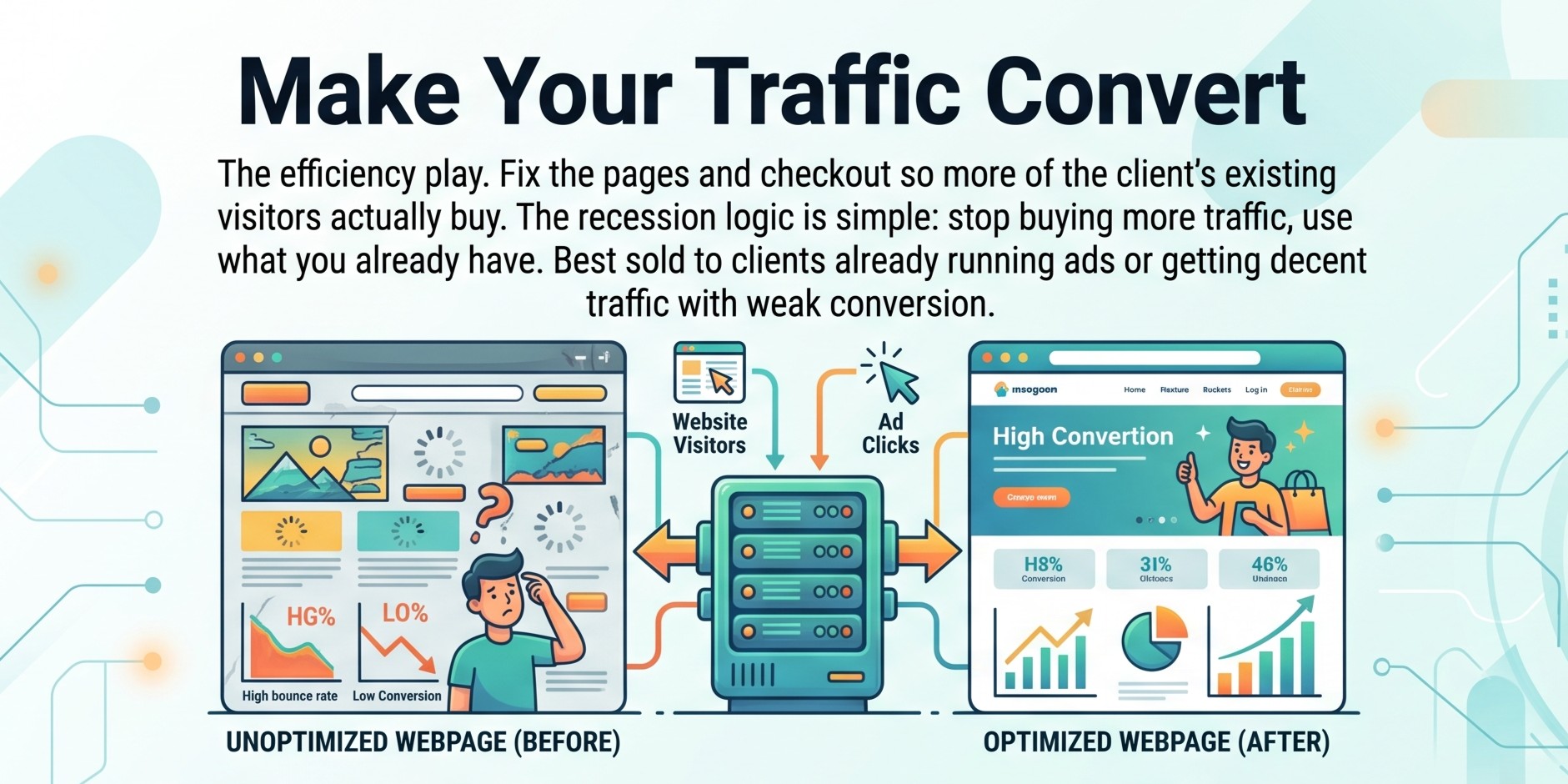
Make Your Traffic Convert
We fix the pages and checkout so more of the visitors you already have actually buy.

Launch Your Product Everywhere Your Customers Are
A complete product campaign — an email series, a landing page, and video and static ads — built to one message and launched for you.

Finding the right connections to build a stronger brand
We find, vet, and reach out to the partners and referrers who can grow your brand's reach — you just approve the list.
Like what you see?
Create your account to request this — and anything else in the catalogue.